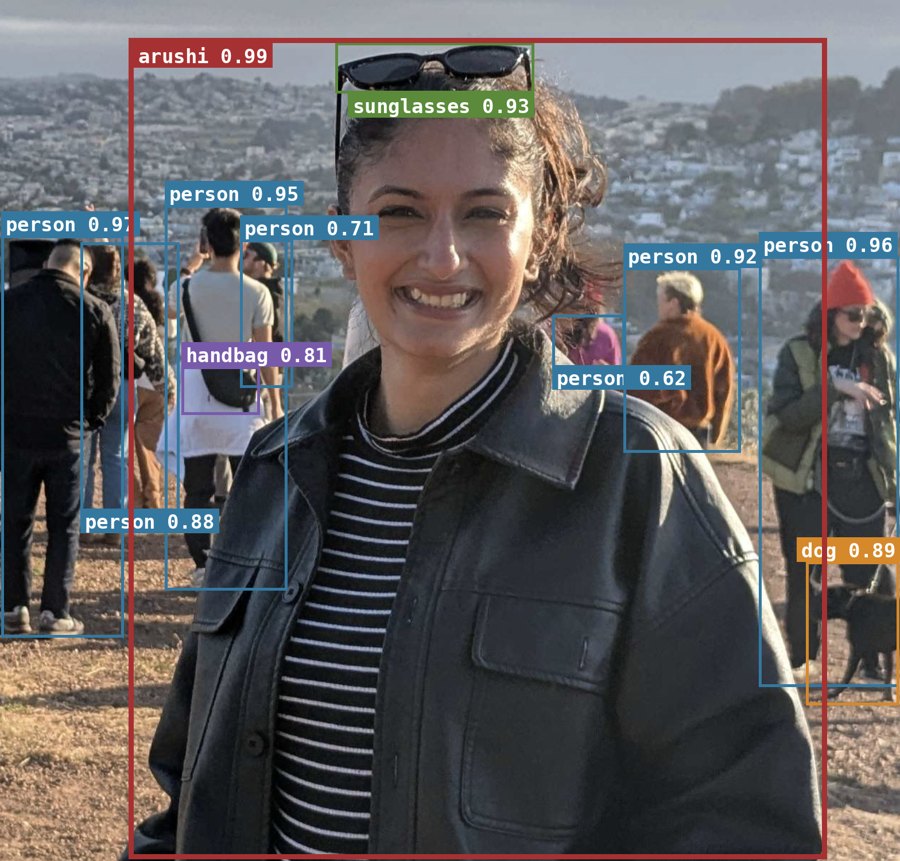
Photo of Arushi Rai with object-detector style boxes: arushi 0.99, sunglasses, people and a dog in the background

Arushi Rai

Research Scientist · Meta

I'm a Research Scientist at Meta, where I joined the recommendation systems team this year. I work on self-improving AI agents for recommender systems and on making multimodal LLMs and embedding models faster at inference, through speculative decoding and related techniques.

I'm finishing my PhD in Computer Science at the University of Pittsburgh with Adriana Kovashka, and I defend on November 13. My PhD work used language to improve video understanding, especially for sports coaching. I also worked on aligning LLMs at test time during an internship at Meta, and on teaching object detectors from noisy captions. Not many people get to be on the forefront of an emerging technology, and I'm grateful for all of it — the thrill and even the overwhelm.

I'm an optimist about AI. The future I want is one where it takes friction out of people's lives, so we have more room for our own goals and creativity. I also feel the uncertainty of this moment. I'm starting a blog to think through both and other AI topics, so stay tuned.

If you have any questions or want to collaborate. Feel free to reach out at arr159 [AT] pitt [DOT] edu.

News

Research

ECCV 2026

Learning Consistent Temporal Grounding between Related Tasks in Sports Coaching

Arushi Rai, Adriana Kovashka

Video-LLMs often attend to the wrong frames. Related tasks — generating feedback and verifying it — must look at the same moments, so we enforce self-consistency between their visual attention, improving grounding without frame-level labels (+14.1% on FitnessQA over SFT).

Findings of ACL 2026

TARo: Token-level Adaptive Routing for LLM Test-time Alignment

Arushi Rai, Qiang Zhang, Hanqing Zeng, Yunkai Zhang, Dipesh Tamboli, Xiangjun Fan, Zhuokai Zhao, Lizhu Zhang

A learnable token-level router decides how much a step-wise reasoning reward model should guide a frozen LLM at each decoding step — up to +22.4% reasoning over the base model, and it transfers from small to large backbones without retraining.

WACV 2026

Generalizing Sports Feedback Generation by Watching Competitions and Reading Books: A Rock Climbing Case Study

Arushi Rai, Adriana Kovashka

Video-LLMs struggle to coach sports they weren't finetuned on. We use freely available competition videos and coaching manuals for the new sport, and propose specificity and actionability metrics for judging feedback quality.

WACV 2025

Rubric-Constrained Figure Skating Scoring

Arushi Rai, Adriana Kovashka

Scores figure skating the way judges do: separating quality from difficulty and grounding each element's grade of execution in the official rubric, for interpretable and explainable scores.

CVPR 2024 Workshop (MMFM)

Strategies to Leverage Foundational Model Knowledge in Object Affordance Grounding

Arushi Rai*, Kyle Buettner*, Adriana Kovashka  (*equal contribution)

LLMs and VLMs know which object parts and attributes enable an action. We use that knowledge to reduce noise in weakly supervised affordance grounding, via a spatial consistency loss and heatmap aggregation.

EACL 2024

VEIL: Vetting Extracted Image Labels from In-the-Wild Captions for Weakly-Supervised Object Detection

Arushi Rai, Adriana Kovashka

Labels pulled from web captions are often wrong. VEIL learns to vet whether an extracted label is actually in the image, improving weakly supervised detection by 30% (31.2 → 40.5 mAP on PASCAL VOC).

CVPR 2023 Workshop (O-DRUM)

Improving Language-Supervised Object Detection with Linguistic Structure Analysis

Arushi Rai, Adriana Kovashka

In-the-wild captions are often narrative rather than descriptive. We classify caption style with linguistic features and filter labels by verb proximity to get cleaner supervision for weakly supervised detection.

Blog

Notes on my research and things I'm learning along the way. The first post is on its way.

visit the blog